úterý 8. prosince 2015

Windberg

So, another post? Yes. The name of this blog involves both my life and math and recently there has been more life and less math in my days, but I've just come back from a sweet math meeting and I want to share with you again.
Happy Nikolaustag! Better late than never!
So, how have I been? Decent enough. Things are getting better for me in Regensburg, I am attending my classes, doing my homework, occasionally preparing at home, the usual, I am even studying bits of German and I like it. I haven't got used to the morning temperatures in my classrooms, though, so usually after my first class I am frozen to the bone, however wrapped-up I might be. Afterwards I usually go back to my room to drink some hot tea and snuggle up under the blankets.

Overall, I like some of my classes, I am making progress in my studies and I try to study some of the books I have long longed to read. Silverman and Cox have been on my bedside table for some time and I even get round to opening the books and marvelling at the wondrous elliptic curves.

Anyhow, Windberg. The annual meeting of the Regensburg Graduiertenkolleg "Curvatures, Cycles and Cohomology". The people there were so nice and lectures fun and accessible and yesterday we had a funny Cohomology evening: a two-hour panoramic view of the various cohomology theories one might encounter in geometry. And it was awesome. Though, we might have enjoyed it more had it not been at 10 pm. 
Windberg Monastery. Sort of looks like Špilberk in Brno.
So, that's it for now. I could not stay in Windberg for longer because of other travel plans but I loved it there and I am feeling postiive now that more math will come and things will get even better for me!

***

And now for the people who are interested in how the evening went: I have not yet decided how to look at cohomology as I am mostly home schooled in this aspect, but for me it is both about invariants of some geometric spaces (for one, the well-behaved cohomology theories are usually homotopy invariant), encompassing geometry of the space (like Chern classes) and obstructions to some constructions (I think of Ext and splitting of short exact sequences, though) in terms of abelian groups. But many smarter people have thought longer about this. So, what have I got out of the talks? (All the misunderstandings are mine, remember, 10 pm.)

So as a prelude we already saw some chain complexes and simplicial homology in the morning and in the evening we started off with de Rham cohomology. For that, you need a smooth manifold and smooth differential forms with the exterior derivative. Surprisingly enough, the cohomology groups do not depend on the complex structure of the manifold as they are the same as singular cohomology with real coefficients. 

Then we moved on to sheaf cohomology, more categorical approach but for me also more appealing: one studies the geometrical objects by means of the functions defined on them. And this approach is absolutely natural because usually objects come with a nicely defined notion of functions on them. And functions describe the world (Tom Garrity). It also paves the way for all the abstract algebraic geometry. But the naive intuition of working with functions works, which is sweet.

The following bit was about Čech cohomology. For that I believe you play with real manifolds and glue functions on open coverings of your space. That is also a very useful concept as so many things are easily defined locally but one would like to piece the information together to get a global thingy. 

The most difficult or advanced topic of the night was crystalline cohomology. Toposes and cycle maps were mentioned (Thank you, Bernard). Anyway, it all comes from the celebrated Weil conjectures (counting points of varieties over finite fields), which would follow from constructing a suitable cohomology theory for varieties over finite fields. To be even more vague and imprecise and silly, you need to lift your curve defined over a finite field to something defined over a field of characteristic zero. Apparently, one can do this locally and then attempt to glue and then I was lost.

We wrapped up the evening with a discussion of how to actually work with cohomology. If we have a class in cohomology, how to decide whether it vanishes or not. The nonvanishing can be done finding a pairing in which the class does not vanish. So we played with compactly supported de Rham cohomology and bounded de Rham cohomology and paired the groups with homology, integrating things and checking well-definedness with Stokes and using the axiom of choice to get some nice limit from a bounded sequence which supposedly amounts to chosing a free ultrafilter on the integers. 

All in all a sweet evening!
Morning Windberg on the day of the cohomology evening. The following morning it was foggy and bleak. 


úterý 6. října 2015

Math holidays vol 2

So, Mainz, stacks, fun, amazing weather, little Leiden. What was next?

Takže Mainz, stacks, spousta zábavy, nádherné počasí, můj malý Leiden. A co bylo dál?

I visited family friends in Darmstadt and they took me to the Frankenstein Castle (among other nice places we visited that weekend)! They saw me grow up, remembered me from times my English constituted only a few questions about their favourite colours (which I had asked everyone around me nevertheless) and we had some very fascinating discussions about modern academic standards at universities, the future of the humankind and my perception of math as philosophy rather than technical, computational science.

Navštívila jsem rodinné přátele v Darmstadtu, a ti mě vzali k Frankensteinově hradu (mezi všemi těmi krásnými místy, co jsme ten víkend viděli).  Znají mě odmala, pamatují si mě z dob, kdy jsem se anglicky uměla zeptat leda tak jaká je jejich oblíbená barva (což jsem se lidí okolo stejně ptala) a vedli jsme spolu několik fascinujících diskuzí o moderním akademickém světě, budoucnosti lidstva a také mému pohledu na matematiku jako spíše filozofii než vědu technickou či výpočtení.

Indeed, what else are we dealing with in maths? Of course, we prove theorems, solve equations, compute expressions. But that is not all of it. An integral part of doing math is thinking about the definitions: what are the properties defining my object? What really makes them what they are? The concept of object really is a fundamental topic in philosophy. And we really spend a lot of time finding the right definition that fits our level of abstraction: that accurately describes our toys and can possibly give us a new insight into what we are playing with, but it can't be too general to allow too many obscure cases that do not allow us to deduce anything specific.

Však vskutku, co jiného v matematice děláme?  Samozřejmě, dokazujeme věty, řešíme rovnice, počítáme výrazy. Ale to není vše. Nedílnou součástí matematiky je rovněž debata o našich definicích: co jsou ony vlastnosti, které určují můj objekt? Co je opravdu dělá tím, čím jsou? Koncept objektu je jedním ze základních oblastí matematiky, kterým se slavně zabýval i Jára Cimrman. A opravdu trávíme spoustu času hledáním správných definic, které jsou dostatečně obecné, aby zahrnuly i nám nové objekty, ale dostatečně přísné, abychom se vyhnuli patologickým případům, které nám zabrání říct o mnoho víc, než říkají naše definice.

Another huge chunk of our time is consumed by justifying our claims. What is truth, anyway? If not the objects, defining, establishing and understanding truth is at the very core of philosophy. And what else do we do than trying to understand what is truth, what constitutes a proof of some statement? But the truth in itself is not our sole interest, we rejoice ourselves in creating hypotheses and following our thoughts processes often ad absurdum... Indeed, many a headache arise from the truths that cannot be proved and many other wonders and paradoxes of logic.

Mnoho času věnujeme taky dokazování našich tvrzení. Co je to vlastně pravda? Pokud ne objekty, definování, rozhodnutí a porozumění pravdy jistě leží v jádru věd filozofických. A co jiného my děláme, než že se snažíme porozumět tomu, co je pravda a co je to důkaz nějakého tvrzení? Ale pravda sama o sobě pro nás není vším, těšíme se z formulování domněnek a následného sledování našich myšlenových proudů až ad absurdum... Vskutku, pravdy, které nejze dokázat a jiné zázraky a paradoxy logiky nám často přivádí bolest ega a hlavy.

And I like to picture us more like ancient philosophers, slowly strolling through olive groves and discussing our thoughts than labouring over the monstrous computations in the solitary confinement of our dark rooms. My imagination might be wild but I am lucky enough to live my dream...

Nesin math village was even closer to my dreams...
A taky si nás ráda představuju jako antické filozofy, jak se pomalu procházíme olivovými hájky a rozmlouváme spolu, sdílíme své myšlenky a představy, nikoliv jak o samotě v temném pokoji toneme ve všech těch šílených výpočtech. Mám možná dobrou představivost, ale taky mám to štěstí žít ve svém snu...
Nesinova matematická vesnice byla ještě blížeji mému snu...

neděle 27. září 2015

Math holidays, part 1

Given that I obtained my bachelor degree only a month ago and knowing that I am going to start a very heavy workload in two weeks, I tried to squeeze in as much rest as I could. I don't think I succeeded very well in resting but overall my month has been good. Next weekend I am already going to move to my new place in Regensburg, but I still have one week to improve what has been one of the most fascinating months in my life.

So what have I done so far? Met many people, heard many interesting stories, saw some amazing places...

First, still exhausted with my exam and a long family lunch the following day, I packed and left for Germany. There I studied algebraic stacks, in Mainz. It was difficult and challenging but I still think I got a lot out of the school, perhaps not as much as others, as my background was not ideal, but I really loved the week full of beautiful algebraic math. I enjoyed both the very categorical reasoning and the purely algebraic ones, moreover, they tied together in an amazing way.

The speakers were of amazing quality and even though 4 lectures a day were a lot (especially for me, with no reasonable mathematical working habits)
this was us after all the lectures at the end of the week
I enjoyed the different flavours the speakers offered. And the people attending were also amazing, I hope I have started several great friendships there and strengthen some old ones, as the place was a bit of Little Leiden for me :)

I started reading FGA explained and was really impressed by the theory. Of course, I haven't got very far, but Angelo Vistoli's part (especially with his excellent exposition live) was very enjoyable for me. I am grateful that I could visit the school and perhaps I will pursue this topic later again, because I am still interested in moduli problems (to which I am indebted to the marvellous Lucia Caporaso), but there is a lot of geometry behind it I need to fill in. But I am working on it!


pondělí 31. srpna 2015

Back after a loooong break

So I am back after a long break. This was an amazing and long month or so. Anyway, what has happened since my last blog post?

  • I got the Third Prize at IMC, just one point away from the Second Prize... I am quite proud of myself. In human terms, I solved 2 problems and got close to solving two more (out of ten), which I managed to finish later on. So given my preparation and different focus in mathematics, I am happy about my result. I had fun and that is what counts. The only cons were the lack of oxygen and impossible heat on the first competition day, pros would include the amazing amounts of melon we managed to eat during those days. All in all, I had some beautiful time in Blagoevgrad.
  • I passed my last exam in algebraic geometry, a skeleton stuck in my closet for more than a year. It felt so beautiful afterwards, such freedom and relief I have not felt in a long time. I am glad I managed to finally learn the classical basics and now I can move on to things I should be studying. Excellent.
  • I took my finals and after a rather hectic and depressing preparation I graduated with honours, so now I will be a bachelor of mathematics (when I get my degree). So, now I am no longer a student, but again, being finally done with my studies in Brno makes me feel very relieved. I am quite proud of myself that I managed to wrap things up so nicely and the final exam was stressful, humiliating just enough to put me back in my place, but also motivating, that I have succeeded in such a long project (3 years of studies are long in my book) and now I feel excited about undertaking more and more exciting goals!
  • I started my more-than-a-month-long Eurotrip. First stop: Mainz. And algebraic stacks. Frankly, this topic is a bit overkill for me and I am not very well prepared (as I was happy to spend most of my summer with my family and in the arms of the man I love), but I am not afraid and so far I think I am doing fine. Today I was taking things easy as it looked like the last day of summer, with the beautiful 33 degrees and Sun and amazing people around me. But tomorrow there is some exciting maths waiting for me, so I look forward to studying more.
And frankly, I am exhausted. Having finished my bachelor just three days ago, left home so suddenly, left my university so suddenly, I feel strange about not belonging where I used to belong for so long. Well, things change and even though I knew this was going to come, it struck me unprepared. So let's hope this one will only bring good things. 
Such marvellous summer this year!

neděle 26. července 2015

The importance of being a problem solver

Nejsou to ještě ani dva dny, co jsem doma (počítáno od příchodu mého batohu), a už se zase balím na novou cestu. Tentokrát je to na matematickou soutěž IMC v bulharském Blagoevgradu. Jaká jsou má očekávání a jaké jsou mé cíle?

It's less than two days that I've been home (counted from the arrival of my baggage) and I am already packing for a new trip. This time it is a mathematical competition IMC in Bulgarian Blagoevgrad. What are my expectations, what are my goals?

Ptáte-li se, co mám společného s problem solvingem a matematickými soutěžemi, musím odpovědět, že ne úplně málo. Ano, i já jsem se (pravda, neúspěšně) pokoušela o matematickou olympiádu, ale to bylo v mých atletických letech, kdy u mne příprava probíhala spíše nárazově, jeden dva dny se u mne nečekaně objevil zájem, ale pak jsem si kdovíkoliv týdnů na žádné příklady ani nevzpomněla.

If you're wondering how I am related to problem solving and all these competitions, I frankly admit that it's not that unrelated. Yes, even I attempted (in all honesty mostly unsuccessfully) mathematical olympiads, but that was in my athletic years, during which I was preparing very irregularly. I would typically get interested for a day or two and then not even think of any problems for many weeks.

Ani korespondenční semináře u mě nevyvolaly snahu připravovat se dlouhodobě. Pro ty, kdož neznáte, u nás působí mnoho skvělých seminářů, které publikují příklady, vy je vyřešíte, do daného termínu odešlete a oni vám je pošlou zpět opravené a ti nejlepší se můžou ulejt ze školy na soustředění, vyhrát zajímavé ceny a setkat se s novýma lidma. Je to skvělý systém a myslím si, že spoustě lidí přinesl opravdu mnoho. Bohužel ve svých atletických letech pro mě týden matematiky uprostřed sezóny nebyla příliš velká motivace. Ani později, když jsem se stala organizátorkou brněnského semináře Brkosu (http://brkos.math.muni.cz/), jsem si k řešení příkladů nevytvořila vztah tak, jak bych byla chtěla.

Not even correspondence seminars fueled the desire in me to prepare consistently. For those of you who do not know this concept, in Czech there are many beautiful seminars posting problems, you solve them and send back the solution before the deadline, get back corrected problems and the best solvers can go to camps, meet awesome people and win interesting prizes. It is a great system and I believe it has given a lot to many people. Unfortunately, in my athletics career a week of not training due to math during the competition season was less of a motivation. Not even when I became an organizer of the math seminar we organize in Brno did I manage to build a relationship with problem solving like the one I wanted.

Ani univerzitní studia mě nepřesvědčily, že bych měla řešit příklady. Většinou vyvolává mírný úděs / úžas, že se u nás rozdávají domácí úkoly pouze výjimečně, na cvikách je málokdy prostředí vhodné k tomu, abych se dokázala soustředit a pracovat samostatně, navíc většina příkladů je mechanických a v lepším případě technických. A tak se velká část mého matematického studia zvrhla k bezhlavému studování teorie. Samozřejmě, je spousta skvělých knih s přehršlí krásných cvičení, ale málokdy se dokážu motivovat natolik, abych u knihy vydržela celou kapitolu a ještě měla sílu a vůli buďto vydržet u deseti stran příkladů či se později vrátit.

Not even the university studies convinced me that I should be solving problems. It usually generated some excitement and horror when I mention that we are hardly ever required to do any homework, tutorial sessions almost always allow me to focus and work on my own and most of the exercises we get are mechanical or technical at best. So the most part of my mathematical studies have become just amassing theory. Of course, there is a great deal of beautiful books with many an interesting problem but I can't really motivate myself to read the whole chapter and still retain the willpower and strength to solve the ten pages of exercises...

Co však s tím? Vždyť matematika je o řešení problémů, narozdíl od těch soutěžních však nevíte předem, že existuje řešení, netušíte, zda už máte prostředky, kterými by váš problém mohl být zdolán. Dala jsem si už spoustu závazků a předsevzetí, ale nikdy jsem nedokázala vydržet u žádného systému (to ovšem souvisí s mou neschopností vydržet u studia déle než pár dní i bez nucení se do frustrujícíh hodin, během kterých vás nic nenapadne a ani po kapitulaci a přečtení si řešení nejste o nic moudřejší pro další příklady).

What should I do then? Math is all about solving problems, even though unlike with the competition ones,  you don't know whether there is a solution, whether you do have he tools to defy your problem. I have had so many resolutions but never managed to keep up any system in the long run (but I have not been able to sustain reliable studying habits even without forcing myself into those frustrating hours during which you can't solve anything and even after surrendering the proofs do not help you anyhow with the next problems).

Jediné, co na mě zatím zapůsobilo, je kolektiv. A proto zítra odjíždím do Bulharska, potkat se s těmi blázny, co zasvětili svůj život řešení problémů, s těmi normálními blázny, co to prostě jen baví, ale taky s těmi, co jsou na tom podobně jako já. Chtěli by, ale zatím si nenašli cestu. Vždyť mě nad tím taky baví přemýšlet, i když nic nevyřeším. Jen se potřebuji vnitřně nastavit tak, abych si na to vše dokázala najít čas...

The only thing working out of me then is the community. And this is why I am going to Bulgaria tomorrow, to meet the madmen who devoted their lives to solving problems, to meet the normal crazy guys who simply like it, but to also meet the people in a position similar to mine. Those who would like to but have not yet found a way. Because I do thinking about it, despite not solving anything. I only need to find the right state of my mind to free up some time for it...

Můj jediný cíl tedy je: odvézt si trochu toho nadšení ostatních, ať vydrží alespoň pár dní!

Therefore, my only goal is this: bring back home at least a bit of the excitement of the others and keep it up for at least a few days!


úterý 14. července 2015

My mathematical life

Because my boyfriend does not know how to use Google translate, I decided to convert my latest post into English. For the Czech version, see http://mujsvetmojematematika.blogspot.com/2015/07/muj-matematicky-zivot.html

Being too restless to think of new things, I decided to share with the world some of the thoughts I have used elsewhere. For instance, this is a part of my effort to convince young ladies during a mentoring program http://www.zenyaveda.cz/ that doing maths can be nice and interesting.

Disclaimer: in exactly the same way I would support any young guys thinking about pursuing a mathematical career. However, I remember quite well how scared I was of my mathematical life, how convinced I was that there is no real place for women in science and that I will never be good enough as of course, women have a different education, social status, we are simply in a different starting position. But whatever, I do what I do, I enjoy what I do, I don't have to prove anything to anyone. I am as good as how well I work on myself. Some might be more talented, some might be faster learners, but who cares,  I study for myself, not for others. I don't believe anymore that maths is a male-only game, it is all about effort, persistence and strain and that can be found in anyone.


So this is my slightly jovial response to what does it mean to study pure mathematics, what do we do afterwards and how easy it is to start studying math. This account of my studies relies almost exclusively on the experience I have had at Masaryk, Brno.

So what is the difference between pure mathematics and applied? It's mostly different in content and attitude. It certainly is not only for the mathematical geniuses from all the Olympiads, on the contrary, those in particular have to deal with a great shock of suddenly starting to study different maths they might not excel at anymore and actually, some of them burn out completely... About lectures - in Brno the approach is very much definition, theorem, proof, it is difficult from the beginning to get oriented, but you should not be afraid of that, it is enough to be active and if you don't understand, get someone to talk you through it, annoy all the people around you to help you explain things again and again, get them to tell you what to read and what to work on.

Pure mathematics should lead towards the world of research mathematics. Therefore, the concepts are more abstract and it is particularly important to interact with senior mathematicians, be interested in what is happening in the world, the math community, it is not just about what you learn in the lectures. For it to make sense, at some point you will have to step out of the safe zone and become interested in things outside - it might sound scary, but definitely with your thesis you will start studying things outside the standard lectures and you will learn how to ask your own questions and pursue your own answers. It might be frightening, but you will learn how to spend your time on mathematics outside the school. At some point, anyone will find a thing that interests them, some things might be boring, but sooner or later something will capture your attention.

In applied math you learn more practical concepts, but many pure mathematicians leave for commercial sectors anyway and we are well sought for, we might not have as much experience with a specific computational software, but we are used to studying difficult, abstract concepts, solving problems for which you do not know in advance whether they will have any solution at all. I myself am a bit skeptical about applied math: for instance, in statistics, you know what kind of answers you are looking for and try to get them!:)

You will be more than fine with just high school math background, but as anywhere else, you will need some time to get acquainted with the new language, concepts and approach, but this is nothing to worry about. What do they want from us in Brno? Not much. Frankly, if you have some good background from your high school, you don't have to do anything until the exam period and for most of the exams (definitely the bachelor ones) I did not need more than a week to prepare, despite having done very little during the semester and despite being no genius, I do have to work hard to get those things done.

What can  you do with pure maths? The most beautiful option is to stay in research, you can do crypto, where they are really in desperate need for mathematicians, you can learn how to code better and be a programmer, you can do "big data" = "big money", a new and exciting field. But even from applied courses in Brno you can get to Berkeley and I got accepted to Cambridge, so the education we get is good enough for many places. Concerning travelling: to get to summer schools is easy, to get enough funding is... sometimes tricky. But I got to many summer schools this year, two of those were organized by the Institute for Advanced Study that mostly covered my expenses and Brno was generous enough to cover the rest, I got to some that cover some subset of room, board and travel expenses. You can't get everywhere you want but I can pick from (for instance if they cannot offer to give me enough support and it wouldn't make much sense for me to go there then).

And what do we do at such summer schools? You attend lectures, solve problems, meet people, travel. For instance, now I am in Utah for 3 weeks, we have 2 lectures a day, a problem session and we are supposed to write a 3-5 page investigation of some topic I am pursuing on my own here for 3 weeks. But you can attend more advanced lectures, research seminars. However, I chose to do most of my mathematical interactions here by talking to people about interesting things, mathematical as well as current affairs and problems. There are two Fields medalists, which is always inspiring to be around, but also many mathematicians who transformed or modernized their fields... I have been lucky to meet some of these superstars in my life and it always inspired me immensely.

However, I do not know your attitude towards math. For me it is a hobby I do enjoy a lot, I might not be as smart or good, but there are things I want to learn and enjoy. Sometimes it is frustrating, sometimes it is difficult, but you don't have to work 24/7 in Brno as is the case at other universities. But it is very much about your motivation and dedication. But if you are interested, in Brno, at any course, almost everybody will be happy to talk to you and support you in anything you might be into. It is enough to be a bit active - see how well it works for me! I don't work hard, frankly, I devote the very minimum to math. But I like it.

And if you do stay in pure mathematics, you will travel. Be it some research stays, summer schools, conferences or even going abroad for good, mathematics is about meeting people and spreading the ideas and learning new things from new places. And it is always great to see how things are done elsewhere.


Můj matematický život

For the English version, see http://mujsvetmojematematika.blogspot.com/2015/07/my-mathematical-life.html


Jsa příliš roztěkaná na to, abych vymýšlela nové věci, rozhodla jsem se alespoň podělit s některými svými myšlenkami, které jsem už sdílela jinde. Například tohle byla má snaha, jak přesvědčit moje mentee v rámci mentorinku  http://www.zenyaveda.cz/, že matematika umí být i krásná a zábavná. 

Pro skeptiky: naprosto stejně bych popořila libovolné kluky, ale sama si dobře pamatuju, jaký jsem měla z matematického života strach, jak jsem byla přesvědčená, že holky stejně vědu dělat nemůžou, že možná pak budu učit, ale nikdy nebudu tak dobrá, jako ostatní, protože ženy přece myslí jinak, než muži, máme jiné "vzdělání", společenské postavení, zkrátka jiné startovní podmínky. Ale to přece nevadí, dělám to, co mě baví, co si užívám, nemusím nikomu nic dokazovat, jsem tak dobrá, jak na sobě pracuji, nic víc, nic míň. Někteří možná mají víc talentu, někteří se učí rychleji, ale co na tom, já studuji sama pro sebe. Nevěřím, že by matematika byla jenom pro chlapy, je to celé o píli, úsilí a houževnatosti, a to se dá najít v každém z nás.

Tohle je tedy lehce nekorektní a žoviální odpověd na to, jaké je to studovat obecnou matematiku, co můžeme dělat dál a jak lehké je začít s matematikou studovat.

Jak se liší obecná matematika od aplikované. Především obsahem a přístupem. Opravdu to není jenom pro génie z olympiád, naopak, ti mívají na vysoké problém, protože najednou nejsou ve všem nejlepší, ta matematika je úplně jiná, tak nezanedbatelná část z nich naprosto vyhoří... Co se týče přednášek - v Brně se to dělá hodně definice věta důkaz, takže je těžké se zorientovat ze začátku, ale není čeho se bát, stačí být aktivní a když něčemu nerozumíš, nesmíš se bát se ptát lidí a uhánět je, aby ti to vysvětlili znovu, aby ti poradili, co začít číst, co dělat a tak.

Obecná matematika tě má dovést k matematice na úrovni aktuálního výzkumu, takže děláš víc abstraktnějších věcí, obecně bys měla víc komunikovat s "dospělými" matematiky a zajímat se o to, co se děje ve světě, není to jenom o tom, co tě naučí v předmětech. Aby to mělo smysl, musíš se časem začít zajímat i o věci mimo tvoje předměty - ale neboj, nejpozději s bakalářkou se stejně dostaneš k něčemu, co už ti lidé přestanou servírovat v přednáškách a naučíš se hledat svoje vlastní otázky a odpovědi. Možná je to teď děsivé, ale časem se v matematice naučíš, že to chce strávit i nějaký čas "mimo" školu. Ale toho se vůbec neboj, časem si každý najde to, co ho zajímá, některé věci tě přestanou zajímat, některé tě nechytnou vůbec, ale až se někde najdeš, nebude ti vadit strávit trochu času navíc u něčeho jiného.

V aplikované matematice se naučíš víc praktičtějších věcí, ale spousta lidí z obecné matematiky (nejen u nás) nakonec odchází do komerční sféry a jsme docela cenění - nemáme sice tolik praxe jako aplikovaní (co se týče speciálních softwarů a třeba numerických triků), ale to všechno se dá naučit a lidi nás berou právě proto, že jsme zvyklí učit se těžké, abstraktní věci, řešit složité abstraktní problémy, u kterých předem nevíš, jaké to bude mít řešení, jestli vůbec nějaké. Já osobně se na aplikovanou matematiku dívám trochu skepticky - třeba u statistiky předem víš, jaké odpovědi bys chtěla dostat a snažíš se je dostat :) :)

Bohatě ti postačí znalosti z gymnázia, ale jako kdekoliv jinde, ze začátku si budeš muset zvykat na nový jazyk a nový přístup, ale vážně se není čeho bát. Co se po nás chce v Brně? Nic moc. Pokud máš dobrý základ ze střední, tak nemusíš nic dělat až do zkouškového, reálně jsem na žádnou ze svých zkoušek (alespoň těch bakalářských, jedna mi trvá dýl) nepotřebovala víc než týden, a to jsem v průběhu semestru málokdy co udělala a vážně nejsem žádný génius, musím si to poctivě odpracovat.

Co můžeš dělat dál - můžeš zůstat ve výzkumu, což je krásná věc, můžeš se vrtnout do kryptografie, kde je dost peněž a zoufale potřebují matematiky, nejenom programátory, naučit se líp programovat a být vyloženě programátor, můžeš dělat "big data" = "big money", velmi moderní záležitost, ke které se můžeš snadno dostat. Ale i třeba z modelování a výpočtů se dá od nás dostat na Berkeley, já se z obecné dostala na Trinity na Cambridge, což je matematicky jedno z nejlepších míst na světě... Takže rozhodně se u nás dá získat vzdělání, které ti otevře cestu kamkoliv.

Co se týče cestování - dostat se na letní školy je jednoduché, dostat na to dostatek financí už je těžší, ale třeba letos jsem se dostala na spoustu letních škol, 2 z nich od Institute for Advanced Study (kde působil třeba Einstein a spousta jiných skvělých vědců), které mi pokryly skoro všechno a na zbytek mi přispěla Masarykova univerzita, za což jsem velmi vděčná, jinak většinou dostaneš nějakou kombinaci z možností ubytování, jídlo, cestovné. Dostat se na takovéhle školy není vůbec těžké, samozřejmě, nevezmou mě všude, ale můžu si vybírat. Několik škol jsem odmítla, když mi nemohli přispět tolik, aby to pro mě mělo smysl :)

A co se na takových letních školách děje - chodíš na přednášky, povídáš si s lidma, cestuješ :) třeba teď jsem 3 týdny v Utahu, máme 2 přednášky denně a jedno cvičení, takže většinu dne máš volno, máme napsat 3-5 stránkový text o něčem, co nás zajímá, něco, na čem si pracuješ sama. Ale můžeš chodit na víc přednášek, vědeckých seminářů, já to ale beru trochu jako dovolenou, tak hodně času strávím jenom povídáním si s lidma, ne pokaždé se bavíme o matematice, ale třeba i o politice, obecných otázkách a jiných věcech. Jsou tu 2 Fieldsovy medailisti, což je prestižní cena pro "mladé" matematiky do 40 let, oba jsou úžasní. Ale je tu spousta opravdu skvělých matematiků, kteří zmodernizovali nebo naprosto změnili oblast svého výzkumu... Potkala jsem několik takových matematických superstar a všichni bylo naprosto úžasní a pokaždé mě to nadchlo.

Nicméně, netuším, jaký vztah máš k matematice. Pro mě je to koníček, hodně mě to baví, i když nejsem tak dobrá, je spousta zajimavých věcí, které se chci naučit, kterým chci rozumět. Ale taky mě to prostě baví, občas se naučit něco zajímavého. Místama je to těžké, frustrující, ale tak je to všude a pro všechny, navíc v Brně opravdu nemusíš dřít 24/7 jako na jiných školách, takže máš spoustu času na všechno ostatní. Ale je to hodně o tvém zájmu, dokud budeš mít chuť něco dělat sama, bude to v Brně skvělé na libovolném oboru, téměř kdokoliv z učitelů tě podpoří v čemkoliv. Stačí být trochu aktivní :) Sama vidíš, jak to funguje u mě - matematice věnuji upřímně minimum, spoustu času proflákám, ale baví mě to a můžu dělat zajímavé věci.

A pokud zůstaneš v obecné matematice, do zahraničí se dostaneš :) Ať už na stáže, konference, studijní pobyty či přímo odejít do zahraničí, v matematice je dokonce potřeba cestovat a setkávat se s lidma odjinud. A je skvělé vidět, jak se věci dělají jinde.

neděle 28. června 2015

Grónsko

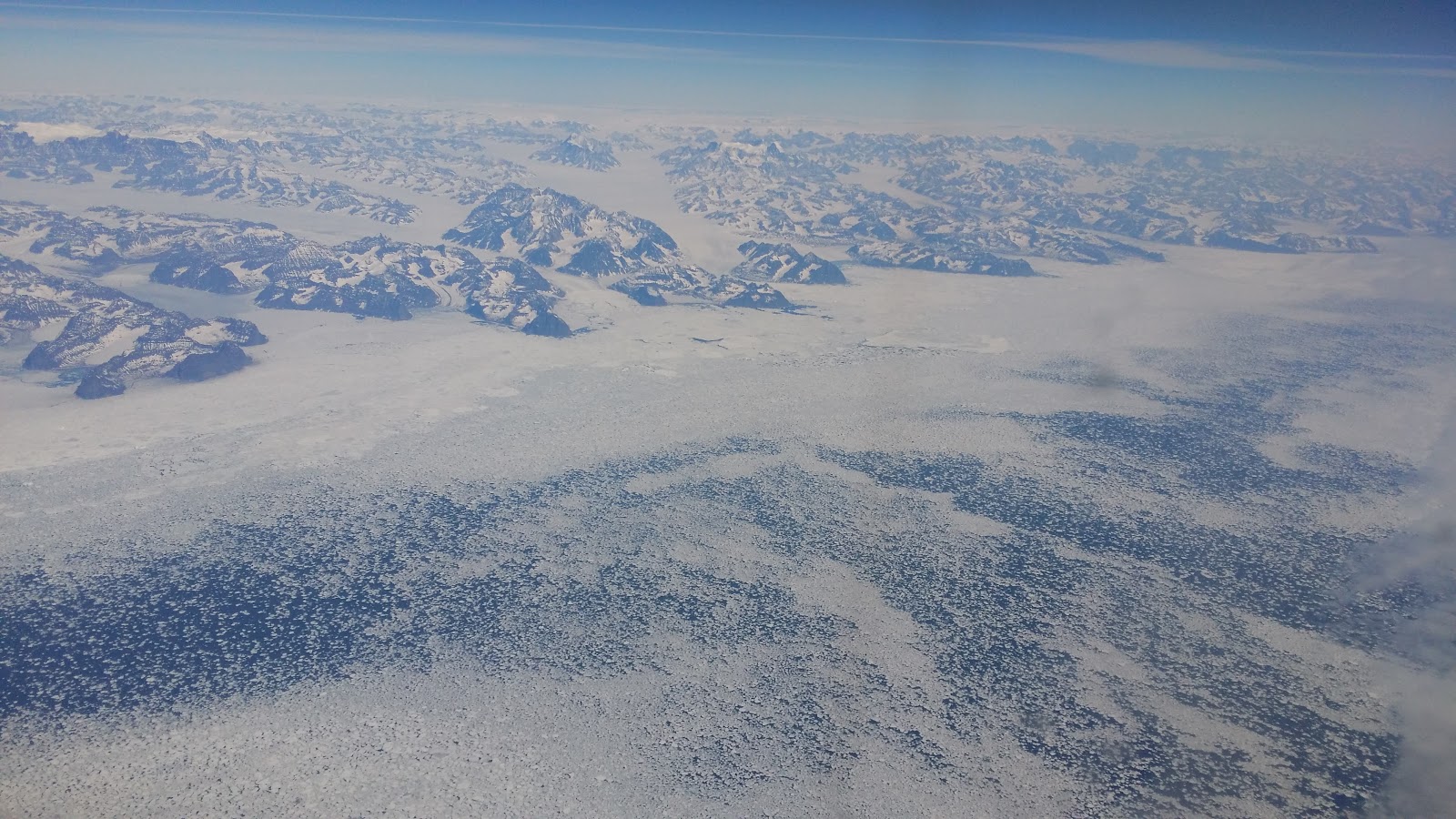
Dnes jsem absolvovala nejkrásnější let v mém životě. Nádherné počasí, dechberoucí výhledy. Snad i díky tomu mi po 10 hodinách v jednom letadle nehráblo. Ale popořádku.

Today was the most beautiful flight in my life. Beautiful weather, breathtaking views. Perhaps even thanks to that I have not gone crazy during those 10 hours in one plane. But first things first.

Můj let L začal v Amsterdamu. Tam teda žádné pěkné počasí nebylo. Pouze šeď, šedošedá šeď. A to žádná módní vojenská, ale zastaralá ocelová šeď. Nad Islandem (díky bohu) ještě bylo zataženo, tak jsem se vyhnula zbytečnému sentimentu. Jenže Grónsko mě dostalo. A to i přes to špinavé okno.

My flight F strarted in Amsterdam. But you can't expect any good weather in Amsterdam. It was just grey, greyish grey. And no modern Military grey, plane outdated Ocean grey. It was still overcast over Iceland (thanks god) so I avoided unnecessary sentiment. But Greenland got me. Despite the dirty window.

Na začátku jsem dlouho jsem přemýšlela, jestli jsou to ještě mraky, když jsem konečně zaostřila na pevninu v pozadí
In the beginning I was wondering for long whether those are still clouds, when I finally focused on the land in the background
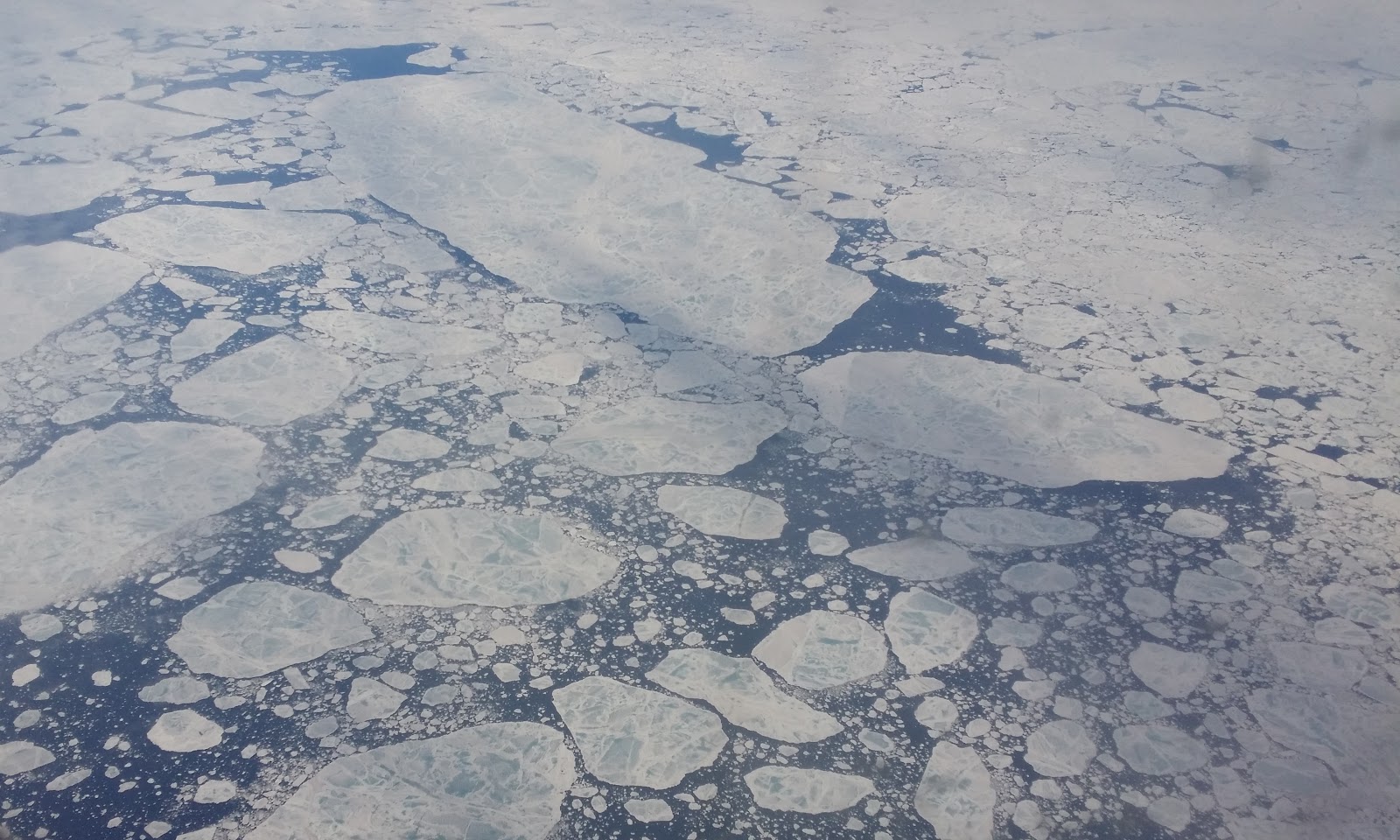
a nevěřila svým očím, až jsme konečně přiletěli blíž, jak se na droboulinké střepiny rozlámal led,
and couldn't believe my eyes, when we finally came closer, how all the ice broke into tiny slivers,
a když jsme přeletěli nad skalnatá pobřeží, pokrytá sněhem a ledem, modrá si vytvořila své cesty, kterým vzdorovaly jenom kusy ledu,
and when we flew above the rocky coast, covered in snow and ice, blue paved its way, defied only by the bits of ice,
aby je přece jen ledovec přemohl mocným pokusem o hladkou bílou pustinu, čemuž se moře urputně bránilo,
and yet be overcome at last by the mighty iceberg's attempt to create a smooth white wasteland, to which the sea fought back fiercely,
a po lítém boji, jehož rozměry plní člověka jak úžasem, tak hrůzou,
and after the savage battle, the scope of which inspires both awe and dread,
vytvořil sníh a led v moři něco, co patří spíše jako snímek do elektronových mikroskopů,
the snow and ice created something seems rather like a picture from an electron microscope
než do arktické pustiny.
than arctic wastelands.

Stále jsem plna až posvátého obdivu k přírodě, která mi dnes ukázala svou krásu v celé své šíři. Hodinový přelet nad Grónskem rozhodně patří k mým nejkrásnějším zážitkům v životě!

I am still full of astonishment by the wonders of the nature that revealed so vastly for me today. One hour flight over Greenland certainly belongs to the most beautiful experiences in my life!

pátek 26. června 2015

Closing thoughts and thunderstorms

So my stay in Leiden is... over? I don't know if that is the right word for that, as I will be coming back to Leiden soon, I will go back there as an Algant master student and I have fallen in love with the place so much that I will definitely want to come back as often as I can. So I can't say that this is over, as I will make sure my bonds with Leiden will continue. 

But my Erasmus exchange is almost over. Unfortunately, these kind of matters always bring along a lot of bureaucracy and administrative issues, so this together with my exams and general exhaustion from all the travelling and arranging matters and most importantly the beautiful weather begging me to be outside and meet people and talk in the sun render finding the mindset for writing for me impossible. And also, I had to somehow cram a whole semester of a tricky course for me into one week, as I had been so overly diligent with my duties this semester...

Anyway, how was my stay in Leiden?

Great. 

Well, it wasn't a very good semester for me, for obvious reasons I could not study as much as I wanted, so frankly, I didn't get that much out of being at such an awesome place as Leiden. I refused to commute for courses so I missed some amazing opportunities to learn new stuff, but I think I still have some time to learn all that. But honestly, had I taken on more courses, it would have been too much for me in the end. So it was a good decision. And I know best how exhausted all the travelling (even commuting) makes me feel.

Also, I couldn't see as much from Holland as I would have loved to see, but again, this was neither my first nor last time in the Netherlands, so I am sure I will get to see all the places I want to visit. And all the lazy days on the beach and biking through the dunes and lovely strolls with my friends or my beloved one in Leiden, that was well worth skipping more famous and touristy places. And I did my fair share of sightseeing in my life, so I don't mind either.

I could have spoken more Dutch, but I learnt enough, I was able to conduct nearly-decent conversations occasionally, so that was not so bad. And considering the amount of stuff I had to learn learn with higher priority, for instance I finally learnt some class field theory I had been fantasizing about learning for several years now <3, I think I did enough.

Of course, I could have talked to people more. But those who know me and understand my shyness and the embarrassment I feel whenever I talk to someone smart (and there are many smart people in Leiden for sure), I am happy I managed to talk to several people I have dreamt about talking to. Surely many more will come, as I will become more relaxed and as I am resolute about doing maths more than twice a week and thus perhaps not forgetting everything before I get back to my studies. Childish naivety, you might object. But I believe in myself, I know that this time things will work out.

So, what next? My plan for the summer is simple: enjoy my well-earned holidays in July, that is, PCMI Summer Session in Utah and IMC in Blagoevgrad and, in August, finally revise my notes from this year and learn properly the things I was so discontinuously trying to study. Now that is naïve.

But I promised a thunderstorm in my title. So here is a video of the most beautiful thunderstorm I have ever seen, descending slowly on my home town Blansko this Monday, June 22nd 2015:


středa 10. června 2015

Travel guide

I travel a lot. Too much, to be honest. I have seen many places on my own, traveled to a different continent completely on my own (though needless to say, New York City is not a wilderness). But my traveling experiences are usually very stressful to everyone around me. I excel in planning my trips way ahead and everything goes indeed very smoothly.

The motivation behind this post is of course my recent very successful booking of my tickets to Salt Lake City. Nevertheless, two weeks later (and two weeks before my departure, ehm) I finally have my tickets. But first things first, here is a list of my favourite traveling adventures that will make your trip unforgettable for everyone:

Nonexistent connections
Undoubtedly the greatest delight from my traveling for my family!
Ideal conditions: Small town with last connection sufficiently early in the evening, ideally after a long and exhausting week.
What to do: Forget that a certain early morning train doesn't go on Saturdays.
How to react: Wake up your family in the middle of the night asking them to drive you somewhere.
Expected results: Harmonious family relationships.

Failure to book I: the plane
This is undoubtedly my specialty.
Ideal conditions: Booking a transatlantic flight last minute.
What to do: Use a technical glitch to interrupt / cancel your reservation just when you submit the details of your credit card.
How to react: Spend several days waiting for customer care to get back to you via email, panicking, as you cannot provide enough information (e.g. no reservation number as technically, that has not happened) for the airline to help you efficiently.
Expected results: Large sum of money frozen on your bank account for a few days, acquisition of the ticket varies with the airline (Delta yes, US Airways no).

Failure to book II: the bus
A more modest but more pressing variant of the previous trick.
Ideal conditions: Booking last minute a bus connection you need to take due to your obligations / arrangements.
What to do: Reserve a ticket but forget to check that it has been successfully paid.
How to react: As before, wake up your family in the middle of the night asking them to drive you somewhere. Alternatively, run for your life to catch the train.
Expected results: Increase in your stamina by taking way less comfortable connections.

Packing frenzy
Especially effective with an early morning departure.
Ideal conditions: 30 minutes before the departure.
What to do: Check the list of things you wanted to pack and realise that your bag contains a mere half with at least 5 items easily procured anytime except for that moment.
How to react: Run around the house / apartment frantically looking for substitutes, rendering your place uninhabitable with all the junk you assess. Especially efficient in tight places with many doors and stairs. Issue search instructions and commands to anyone around, moving quickly to avoid any resistance.
Expected results: First hours after arrival to your destination will be devoted to sorting out your supplies and getting the missing essentials. 

Please bear in mind that to perform these tricks successfully, you need to repeat them roughly every two weeks or so.

I hope this will be a nice piece of inspiration for your upcoming travels!

Horrified I await how will my moving out look like.